Showing posts with label Stock Investment. Show all posts

Friday, 6 September 2019

How am I starting on my Technical Analysis journey?


My core investment skills come from fundamental analysis. TA is relatively different and requires me to develop different skillsets. For past few months, I have been working hard to improve my Technical Analysis and trading skillsets.

Recently bought a book: “Trading: Technical Analysis Masterclass” (This is an affiliate link. See disclosure below) by Rolf Schlotmann / Moritz Czubatinski, which provides good and clear explanation of the basics. Have personally found this book to be really useful and will recommend new traders to take a look.

So how am I starting my TA journey? I first set aside a sum of money for short-term trading:
(1)   Near-term and daily needs in high deposit bank accounts
(2)  Emergency funds in short-term fixed deposits
(3)  Stocks
(4) Investment Warchest in Singapore Savings Bonds and high deposit bank accounts.
(5)  Currency
(6) Short-term trading – NEW!

This is a sum that could potentially become my “school fees”. Before each trade, I worked out a plan and identified the potential upside/downside % as well as the entry, exit and cut-loss prices. I also used indicators such as Candlestick, RSI and MACD to guide me.

While the general trend of overall stock market trend seemed bearish, I spotted potential uptrend opportunities for OCBC, DBS, Hong Kong Land, SATS Limited. Hence, I took the calculated risk to buy in and am currently monitoring the charts closely. Have earned a small profit from trading STI ETF. Not a bad start, I guess? Will share some charts and analysis in my future posts. 😊

Disclosure: The link for "Trading: Technical Analysis Masterclass" is an affiliate link. At no additional cost to you, I will earn a commission if you click through and make a purchase.


GoHuat

Saturday, 3 August 2019

Market Watch 2019 – SG Banks


In our previous post, we shared our plans to diversify our investment portfolio. Since then, my wife and I sold half of our OCBC shares at $11.50 and CPFIS’s STI ETF at around $3.41 to build up investment war-chest as well as protect overall profits in our CPF portfolio.

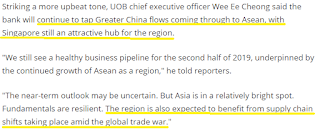
We kept a constant look out for trigger news e.g SG banks’ Q3 financial results this week, to gather information to help us assess the general impact from the trade war climate. Key points from CEOs of the three banks

DBS CEO - Source: Business Times

OCBC CEO - Source: Business Times

UOB CEO - Source: Business Times

To us, it is important to understand how the banks position themselves. We are keen on their strategy to support new business models and shifts in supply chain e.g. market positioning, shift in loan strategy, etc. Overall, we remained positive on the prospects in the Greater China and ASEAN market. To this end, my view is that OCBC and UOB are better positioned.

OCBC have strong exposure in Greater China, Malaysia and Indonesia. There were reports on their plans to increase stakes in Bank of Ningbo. If this materialises, OCBC’s deeper presence in Greater China could open up more opportunities to the wider Chinese market and position them well for China’s One Belt One Road initiative.


UOB have a good presence in Thailand and broad network in Malaysia, Indonesia and China. After setting up their digital bank in Thailand, there were reports of UOB considering to launch digital bank in Vietnam or Indonesia too. Both countries possess abundant opportunities. They are likely to come from the shift in supply chain from China to Vietnam, as well as from Indonesia's plans to shift their Capital which would require significant amount of infrastructure loans and investments. 

Trump’s tariff hike on Chinese imports had came in rather abruptly and have caused a stir to the stock market.

This looks like a buying opportunity... and our war-chest stands ready to fire.

GoHuat

Related Post
1.       Signs of market downturn coming?

Tuesday, 9 July 2019

Signs of market downturn coming?


Global banks are often the front-runners for a market downturn (e.g. bad debts, poor loan repayment, staff retrenchment, etc). Over the past 2 days, three news caught my eye:
  • Deutsche Bank staff sent home as 18,000 job cuts begin (The Guardian, CNBC, 8 & 9 Jul 2019)
  • Yield on the benchmark 30-year US Treasury bond briefly dipped below 2.5%, yielding less than the Federal Reserve’s short-term federal fund rate (CNN, 8 Jul 2019)
  • Temasek Holdings one-year return for shareholders came in at 1.49%, down from 12.19% in the previous financial year (Straits Times, 9 Jul 2019)

The warning signs of a global market downturn have grown even stronger. For the past 2 years, our Singapore leaders have been warning the people to be more conservative through policies such as property cooling measures and public speeches. 

Even if a market downturn is more likely now, it is still impossible to time when it would actually take place. My best guess is to be around the U.S. Presidential mid-term election period (Oct-Nov 2020 time-frame). But surely many people out there would also share similar thoughts. So how accurate would this guess be? 

Instead of timing the market, my wife and I decided to diversify our investment portfolio from stocks. We considered buying currency, gold, bonds or simply build up our investment war-chest. For gold, we were doubtful if the returns were worthwhile as the US$ would likely weaken when global economy tanks. For corporate bonds, most bond returns seems unattractive with its risks. In the end, we chose to buy currency - RMB Yuan. We will elaborate more on our decision in our next post.

Do you think that a market downturn is coming soon? Feel free to share your thoughts!

GoHuat

Monday, 1 January 2018

Looking back at 2017 & setting Family Finance resolutions for 2018!


I hope everyone out there have already set your resolutions for the New Year?? After all the excitement of setting them, we usually find it challenging to keep track especially when our busy schedule takes control. Let us take a look at how our family finance performed in 2017 and our target for 2018:
Savings
We saved 57% of our total annual income from salary, 7% more than our target. Despite an increase in the number of overseas travels, we managed to keep our dollars in control with our savvyness. Will elaborate more in future posts. In 2018, we would need to spend more on the purchase of new household items including furnitures, kitchen appliances, as we would be settling into our new house. Based on our cash flow forecast, our expected savings for 2018 should be around 29%. We intend to go for a stretch target of 35%.
Stock Investment
Based on trading gains and stock dividends, our investment rate of return has improved from 3.55% in 2016 to 4.6% in 2017, 0.6% above our 2017 target. We are targeting a rate of return of 5% in 2018.
Emergency Funds & Cash War-chest
Our cash is divided into emergency funds (for urgent needs) and cash war-chest (for investment). In 2017, our emergency funds have expanded from 18 to 24 months of our monthly expenditure. Our war-chest has increased to form 25% of total portfolio and we intend to continue increasing it to at least 30% in 2018. We are also thinking of putting some spare cash into currency, likely Chinese Renminbi, but have not made a decision yet.
Overall, we managed to achieve our 2017 targets. The Singapore stock market has been trading sideways over a range of 3000-3400 this year. We believe 2018 will be a more challenging year for investment and will likely be adopting a more cautious approach for our investments. 
We have reached the end of our first 2018 post. Here, we wish our readers a prosperous and fulfilling 2018! Invest well and may all of you continue to advance towards your financial goals this year!